Image copyrightDave RennieImage caption Free to new owner - but they have to move the house to a new location
A housing developer is giving away one of his properties for free to a needy family in New Zealand's largest city, but they will have to find somewhere to put it.
Auckland businessman Dave Rennie has listed the three-bedroom property with a zero-dollar price tag, with the proviso that the buyers move it to their own plot of land, the Newshub website reports. Mr Rennie told Newshub that the house is one of 16 he owns, but it stands on land that's due to be redeveloped.
"It seemed like a waste and it was a shame for it not to be utilised. It might be a good starting point for somebody," he said.
According to stuff.co.nz, the single-storey house might be reasonably valued at between NZ$75,000-100,000 ($52,000-69,000; £42,000-56,000). The relocation could cost $24,000 on top of the price of a suitable plot of land.
The offer comes after a report which names New Zealand the most unaffordable property market in the world. Citing a study published by The Economist, Newshub says that the country has shown the highest rise in house prices, is the costliest in terms of average incomes, and has the biggest difference between house prices and renting prices.
Despite interest in the free house, no-one has taken up the offer since it was listed in February, Mr Rennie said.
Next story: IKEA builds housing for its Icelandic staff
Use #NewsfromElsewhere to stay up-to-date with our reports via Twitter.
Media captionMeet the teenagers from Citizen Challenge.
Votes have no colour, religion or class, so why so few election posters in multi-ethnic La Busserine?
About 3,000 people (nobody seems to know for sure) are packed into this 1960s housing estate in northern Marseille and they have some serious issues.
Think "ghetto" and you are on the right track.
La Busserine is in the 14th Arrondissement, a district which made national headlines in 2014 when, together with the neighbouring 13th, it elected the city's first (sector-level) mayor from the far right National Front (more on that later).
Yet over two days, the only traces I found of this month's presidential election were a few posters for radical leftist Jean-Luc Mélenchon.
Marseille's 14th Arrondissement
The numbers that count
24.96% abstention in 2012 presidential run-off (19.66% in France nationally)
61,186 residents (Marseille population 855,393)
3,721.8 residents per sq km (103.6 nationally)
29.3% unemployed (13.6% nationally)
39.6% in poverty (14% nationally)
Source: Official statistics 2013
But one group of first-time voters do not need posters because they have smartphones and can tell their Macron from their Hamon by actually reading their manifestos.
These daughters and sons of Comorans, Moroccans and other immigrants want to reconnect their neighbours to politics.
Oh and they are looking for a party of the other kind too.
Did someone say party?
Fifty areas in 34 towns and cities across France are competing to see who can reduce electoral abstention the most.
Citizen Challenge (in French) was launched in the deprived Strasbourg suburb of Neuhof after 80% of voters there stayed away from the first round of regional elections in December 2015.
Image caption Razia Mohamed Zaki (centre) and Delphine Soumalia (sitting beside little Delyha) are also part of Citizen Challenge, along with Sarah Mmamdi (right)
A video (in French) which features kids daring adults to get out and vote for their future got more than 200,000 views on YouTube and abstention fell to 70% in the second round, Neuhof community centre director Khoutir Khechab explains.
He and his team are negotiating with public bodies and bands to come up with the prize: a concert in the winning area.
French election: Everything you need to know
Strasbourg's grassroots campaign
What's on people's minds?
Elections come and go but on the estate, a place full of children, people have been sinking under the same issues for years.
One issue comes around ten o'clock in the morning as the spotters emerge into the sun to watch over the estate's notorious hashish trade. Another emerges after dark when the réseaux (drug gangs) settle scores, sometimes with a kalash (Kalashnikov).
And morning, noon and night, the issues of unemployment and poverty hang over this community living 8km (five miles) from the luxury boutiques and restaurants of Marseille's Vieux Port (city centre).
Discrimination is also a live issue for the numerous Muslims here. Some 200,000 live in Marseille (population 855,393 as of 2013), according to French media.
"Muslims here are like disabled people," says a local shipyard worker of Algerian ancestry who does not want to be named.
Image caption Bullet holes at an abandoned flat on the Flamants estate, adjacent to La Busserine
"If your name is Mohamed it's like you're missing an arm or a foot or a face. We're given all the hard work, the dirtiest work, the worst jobs."
People take some persuading, right?
"It's called a challenge because it's not easy," says French radio correspondent Stephane Burgatt, who followed the group around the flats of La Busserine in December.
"It's the kind of place where most people don't care about politics and don't know for whom to vote."
Image caption A Citizen Challenge event in La Busserine last month brought in people from across Marseille
First-time voters Amal Osman, 18, Mohamed Abdallah, 19, and Sarah Mmadi, 18, are among a couple of dozen activists who went door to door persuading people to register to vote.
Today, equipped with props like a mock polling station, they focus on reminding voters in La Busserine (70% abstention at the regional elections) to actually use their ballots.
The bright side of France's migrant suburbs
Do Muslims vote for the National Front?
The 14th, a working-class district, traditionally voted Communist or Socialist but in 2014 voters swung to the far right. Most of the Front's support came from outside the housing estates, among white voters.
However it is clear that some Muslims also voted for Stephane Ravier as their mayor despite his party's hard line on Islam and mass immigration, says Richard Ghevontian, a politics expert at Aix Marseille University.
Image caption Professor Ghevontian says uncertainty over the election's outcome is unprecedented
"[Socialist President Francois] Hollande's policies disappointed many and Marriage For Everyone [the Socialists' same-sex marriage act of 2013, opposed by the National Front] greatly shocked Muslims, who are extremely conservative on social matters," he says, citing opinion surveys.
"It was a vote to punish Hollande," says a teacher in La Busserine, who does not want to be identified.
The shipyard worker, like nearly every voter I spoke to on the estate, is voting for Mr Mélenchon. "He tells the truth and a vote for him is a vote for peace with Muslims," he explains.
And three years under Mayor Ravier? "He does nothing for us but he leaves us alone," he says with a shrug.
Who are the candidates?
What can Citizen Challenge really achieve?
France was once a model for voter turnout in the EU, says Professor Ghevontian, but in this election there is a real concern that abstention may rise.
If election campaigners do not go into places like La Busserine, it is because they have become no-go areas even for the police, he says.
Image caption Marseille is France's second-biggest city
Yet the first-time voters keep up their campaign, encouraged by growing publicity for their cause and, crucially, the 100 or so people who registered to vote after talking to them.
"Citizen Challenge is good for the young because it gets them active and gives them a bit more value as human beings and citizens," says the teacher, "but our politicians live on another planet and they need to come back down to Earth."
Image caption Patrick Housseini runs the estate's football team, AS Busserine
Will La Busserine win the concert? Street parties are an old and happy tradition in other parts of Marseille, with free concerts and kids' activities.
There is a real appetite on the estate for breaking out of the social isolation. AS Busserine football club inspires a loyal following and the Agora social centre runs clubs.
Sarah, who still remembers the fear of failure she felt as she knocked on her first door last year, says: "Our aim is to revive the area because the life went out of it."
"We got together to show the little ones that there is a good path and a bad path and they can choose the right one," says Amal. "Citizen Challenge lets them see the world of politics. It's only the beginning."
Graphics by Mike Hills and David Molloy
More on Patrick's Marseille assignment in this Twitter Moment.
Read more about France's presidential election
The election explained in five charts
Marine Le Pen: The battle to be president
The young alt-right making waves
Election Tour de France: South-west voters want change
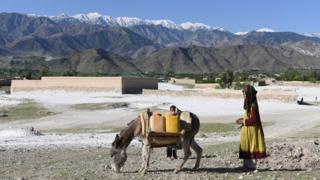
Image copyrightEuropean Photopress AgencyImage caption The mountains targeted are found in the Achin district of Nangarhar province
Donald Trump has not only normalised American foreign policy, he has arguably made it more effective.
With two high-profile, signal-sending bombing raids and a series of breathtaking policy reversals, President Trump has brought US foreign policy back in line with conventional thinking. But he has added to the equation a measure of force that gives Washington new clout.
When policy shifts so dramatically and with such little explanation, it can obviously shift again.
So we don't know how long the new positions will last. Nato could be back out of favour, Putin back in, simply with a couple of 140-character tweets.
But Donald Trump is a voracious consumer of cable television and the hunch is he will like the near-universal praise he's been getting on US talk shows this week.
There are clearly glaring inconsistencies in his new foreign policies - he bombs a Syrian air base because of the suffering of Syrian babies, but bans Syrian refugees from entering America.
There are pitfalls too. His switch on China appears largely based on a good rapport with Xi Jinping in Mar-a-Lago, but China still has interests which are not in sync with America's - its expansion in the South China Seas is just one.
Image copyrightReuters
But, as one Republican put it to me this week, Mr Trump has begun to know what he doesn't know. That's important. He has begun to understand that the world is more complicated than he thought.
You can laugh all you like at the sight of Mr Trump getting so publicly tutored on China, North Korea, the Export-Import bank and currency manipulation. Of course it was foolish to promise simple solutions to complex problems. But it's better to learn now how difficult those things are than never to learn at all.
One dizzying day of Trump U-turns
His recent praise of Nato and rejection of Moscow immediately put this White House more in sync with European allies.
Europe has long believed that the real threat to global security comes from Russia, not China. That's not what millions of Mr Trump's voters believe. He will have to keep them in mind as he backs away from calling China a currency manipulator and slapping it with tariffs, as he had promised he would do in the campaign.
But the shifts do bring America back into the foreign policy mainstream.
Media playback is unsupported on your device
Media captionIt felt like the sky was coming down, villagers told journalist Bilal Sarwary
The use of force, in Syria and Afghanistan, meanwhile, sends the message to America's adversaries that Mr Trump is not as war-averse as his predecessor.
The White House was delighted that Xi Jinping got to hear the news, over dessert in Mar-a-Lago, that the US had bombed Syria. They wanted him to get the message that there's a new sheriff in town - and ideally to pass that message on to their contacts in Pyongyang.
Those Tomahawks launched against the Shayrat air base didn't really do much to limit Syria's military capability, but they did send several effective signals to Syria and its friends.
First, using chemical weapons against civilians will have consequences. Second, this is a president who is prepared to use force fast and with no warning - Trump isn't paralysed by analysis which was the criticism of Barack Obama.
Third, and perhaps more critical, it gave Secretary of State Rex Tillerson a large stick to pack in his luggage for his trip to Moscow.
Syrian American responds to Trump and Assad
What is Trump's plan in Syria?
How North Korea is testing the US
Mr Obama's secretary of state, John Kerry, negotiated over Syria for years with no leverage because the Russians knew his boss wouldn't sanction the use of force - not so anymore.
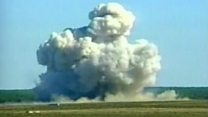
There was similar messaging printed on that massive bomb dropped on suspected Islamic State militants in Afghanistan this week. Dropping a big bomb is one thing, but you get a lot more attention when that bomb is rather gruesomely nicknamed "the mother of all bombs".
It wasn't just a bomb, it was the biggest conventional weapon ever used in combat. It was positively Trumpian.
That MOAB also sent signals. Mr Trump told his supporters during the campaign that his number one foreign policy priority was defeating so-called Islamic State. Some of those voters were not thrilled then that his first military intervention was in response to the suffering of Syrian children.
They are suspicious of America getting dragged into more Middle East conflicts that don't help US interests. Bombing IS was a reminder that Mr Trump is focused on what he calls America's number one national security challenge.
Image copyrightEPAImage caption US Secretary of State Rex Tillerson met Russian Foreign Minister Sergei Lavrov in Moscow
Ahead of the Easter weekend, with North Korea rumbling about a nuclear test, the Afghan strike may also have served as another reminder to Pyongyang that Mr Trump has big, bunker-busting weapons and will use them.
So, in two short weeks, and with a new and more professional team in the White House, Mr Trump has stabilised foreign policy. Allies will wait to see if the change lasts and who really speaks for the president. But for the moment there is a collective sigh of relief that American leadership may be back in more conventional hands.
Very soon, the focus will shift back to domestic policy and there Mr Trump has more of a challenge. He needs a legislative win fast. When Congress returns in a week, he will tackle health care, again, tax reform and he faces a government shutdown over America's debt limit. Failure on those will quickly shift the tone of the TV commentators.
Image copyrightReutersImage caption A 300m (328yds) long network of tunnels and caves was destroyed
President Trump has no domestic equivalent of the confident, competent General H R McMaster, his new national security adviser.
The Republican party is divided and the conservative wing has already shown it is prepared to say no to the president. Democrats, having been berated on Twitter and on TV by Mr Trump, are now in no mood to abandon their angry liberal base and work with him.
Mr Trump has had a good couple of weeks. He has shown a capacity to learn and adapt as a result. He has begun to understand what he doesn't know and he has marginalised the more populist members of his team.
He wants successes. It is easier for him to get them on the world stage than at home - it would be ironic if America's isolationist president now decided to become a foreign policy president because that's where the wins are.
Image copyrightAnimal Adventure ParkImage caption "We have a baby!": April and her calf enjoy their first moments together
At long, long last, after what seemed like aeons, the world's most famous giraffe has given birth.
April the Giraffe, whose prolonged pregnancy has been watched by millions of amateur zoologists online, has delivered her fourth calf.
"We have a baby! Everything went absolutely perfect. This is great!" park owner Jordan Patch said.
Since a live feed of her enclosure started in February, she has become an internet celebrity.
There are no details on the gender of the calf yet. The mother, whose every move has been closely followed, and baby are said to be fine.
The delivery does not mean they are going away from the public's eyes. There will be a competition to determine the calf's name.
More on April's journey
How it all unfolded
Zoo babies since her live stream started
Watch the Animal Adventure Park live feed
Now mom will raise the calf, and weaning could take between six to 10 months, the park explains.
The young giraffe will then be moved to another facility for a breeding programme.
April's delivery has not been without (virtual) hurdles.
Her live feed was briefly removed from YouTube in February after it was flagged as being sexually explicit or having nude content.
The park blamed animal rights activists for reporting the video as inappropriate, a move that infuriated her followers. But, to their relief, the ban was short lived.
Media playback is unsupported on your device
Media captionApril the giraffe's every movement, however dull, has been broadcast
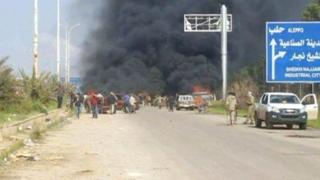
Image copyrightReutersImage caption Smoke billowed over the blast site
A huge car bomb has blasted a convoy of coaches carrying evacuees from government-held towns in Syria, killing at least 39 people, state media report.
It shattered coaches and set cars on fire, leaving a trail of bodies including children, as the convoy waited in rebel territory at Rashidin.
Russian troops have reportedly moved to shield rebel evacuees from retaliation.
Thousands of evacuees from both sides of Syria's civil war have been stuck in hostile territory since Friday.
The "Four Towns" deal was meant to relieve suffering in areas under siege.
Some 30,000 besieged people would be taken out of two rebel-held towns and two under government control but, according to AFP __news agency, up to 5,000 government evacuees and 2,200 from rebel towns are now stranded.
Last month, the UN described the situation in the pro-government north-western towns of Foah and Kefraya, and the rebel-held towns of Madaya and Zabadani near Damascus, as "catastrophic".
More than 64,000 civilians are "trapped in a cycle of daily violence and deprivation", it said.
'Starving to death' in Madaya
Madaya, where children resort to suicide
Why is there a war in Syria?
'Protect us'
The bomb reportedly went off around 15:30 local time (12:30 GMT) at the checkpoint where the handover was due to take place.
Syrian state media reported 39 deaths while the 24Aleppo __news site quoted its own source as saying 60 civilians had been killed.
A suicide bomber driving a van supposedly carrying aid supplies blew it up near the coaches, the UK-based Syrian Observatory for Human Rights reports.
Images from the scene show bodies lying on the ground outside blackened and devastated coaches.
The complex choreography of this exchange has been attempted before on a smaller scale, reports Sebastian Usher, the BBC's Arab affairs editor.
There must now be concern over whether it can continue at all, he adds.
An AFP correspondent west of Aleppo, speaking before the explosion, said the coaches carrying government evacuees had not moved in 30 hours.
The Syrian Arab Red Crescent was distributing food and water to the waiting passengers, who include 3,700 civilians, the agency adds.
Image copyrightReutersImage caption Evacuees like these from the government towns have been waiting for hours
Rebels say Damascus breached the terms of the deal brokered by Iran and Qatar, accusing the government of trying to bring out more loyalist fighters than agreed.
According to an 24Aleppo tweet, a special unit of the Russian army surrounded the convoy from the rebel-held towns after the bombing and closed the road there to "prevent any reaction".
Evacuees from Madaya called on international organisations to protect them from any possible retaliation, saying they condemned the attack on the other convoy.
"Everyone here is on a tether following the Rashidin bombing," they said in a statement.
"We are holding the guarantors of the Four Towns deal responsible for our safety as the Shia towns and regime troops around us are on the highest alert."
"There's no drinking water or food," Madaya resident Ahmed, 24, told Reuters news agency earlier, speaking from the bus garage in Aleppo where he and others had been reportedly waiting since Friday night.
"The bus garage is small so there's not much space to move around. We're sad and angry about what has happened."
Image copyrightReutersImage caption Dozens of buses are being used in the evacuation
The evacuees are meant to be transferred to rebel-held territory in Idlib province.
Many people are reported to have died as a result of shortages of food or medicine in the four towns.
Foah and Kefraya, most of whose residents are Shia Muslims, have been encircled by rebels and al-Qaeda-linked Sunni Muslim jihadists since March 2015.
Madaya and Zabadani, which are predominantly Sunni, have been besieged since June 2015 by the Syrian army and fighters from Lebanon's Shia Muslim Hezbollah movement.
A previous attempt at mutual evacuations failed in December when rebels burnt coaches due to be sent to the towns.